Evidence-Based AI Engineering · Technical brief
Capability Is Not Reliability
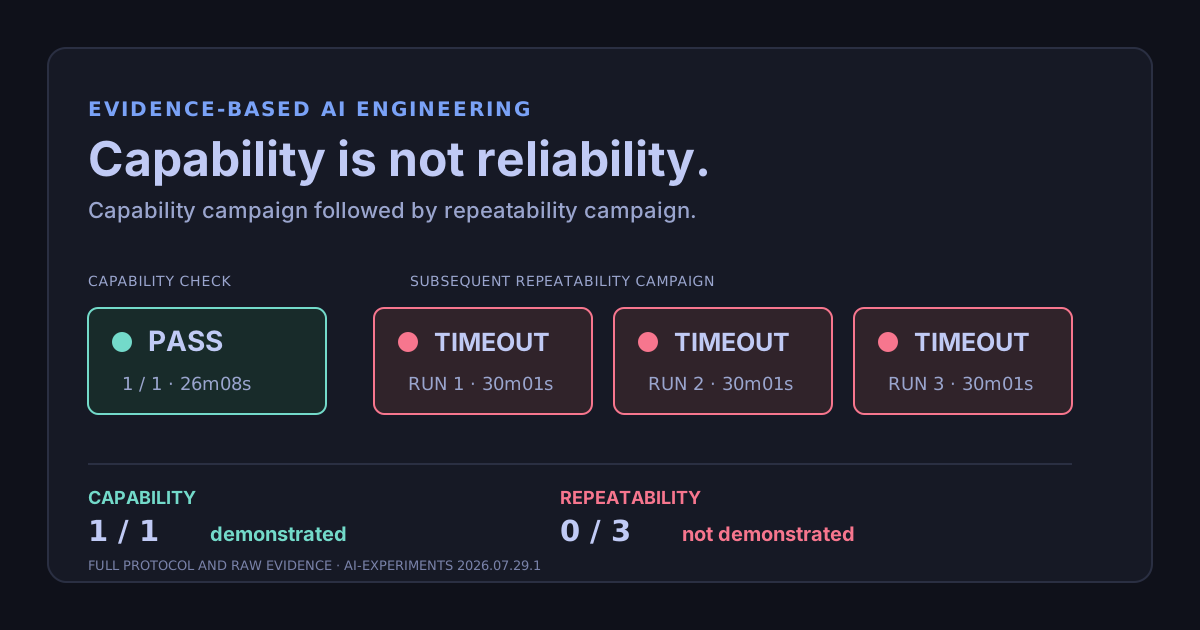
Yesterday I watched a local coding agent solve a security-sensitive task. It changed one Go file, preserved the public API, passed the test suite under the race detector, and passed static analysis. It used no hosted model and incurred no API cost.
Then I ran the same configuration three more times.
Every run timed out.
That sequence captures a distinction we routinely blur when evaluating AI systems:
A successful run demonstrates capability. It does not establish reliability.
The first result answers whether the system can produce a valid solution. It does not tell us how often the solution will appear, how sensitive the outcome is to sampling, or whether the system is safe to use without supervision.
Those questions require controlled repetition and retained evidence.
Why demonstrations are persuasive
A good agent transcript resembles engineering work. The model inspects files, forms a plan, edits code, runs tests, reacts to failures, and eventually announces completion. When the final diff is correct, the trajectory feels like proof.
But it remains one observation.
The visible run may also be the survivor of prompt changes, model selection, context tuning, retries, and discarded attempts. The audience sees the coherent result. The operator remembers the search process. If failed runs are not preserved, neither can measure what the demonstration represents.
This is not unique to AI. Engineering disciplines distinguish a prototype that works once from a process that performs consistently. Agent evaluation should do the same.
The experiment
The task was intentionally small but adversarial. A Go package wrote named files beneath a configured root. The implementation had to preserve legitimate nested paths while rejecting absolute paths, parent traversal, and escape through a pre-existing symlink.
The executable contract also protected against a tempting shortcut. A filename
such as reports/v1..v2.txt had to remain valid. An earlier model appeared to
solve traversal by rejecting every string containing two adjacent dots. Human
review showed that it had prohibited a substring, not secured the filesystem.
After strengthening the fixture, I ran Devstral Small 2 locally through Ollama. At a 16,384-token context, Ollama reported a 17 GB footprint and full GPU residency on an Apple M1 Pro.
The capability check passed in 26 minutes and 8 seconds:
go test -count=1 -race ./...    PASS
go vet ./...                    PASS
I then ran a separate three-repetition campaign. Every repetition started from a fresh workspace, required a failing baseline, used the same model profile, context, verification commands, retry limit, and 30-minute budget.
All three timed out.
Two attempts rejected legitimate nested paths. Another accepted an absolute path and a symlink escape. The model understood much of the problem and produced substantive changes. It did not converge within the declared budget.
The conclusion is neither “local models work” nor “local models are useless.” It is narrower and more useful:
This configuration demonstrated bounded capability. It did not demonstrate repeatable reliability.
Evidence changes the engineering conversation
A pass rate alone is insufficient. To understand an agent run, I want the initial repository, exact task and configuration, clean workspace, command stream, produced patch, deterministic verification output, final snapshot, duration, exit status, and the failures from unsuccessful repetitions.
Negative artifacts often contain more engineering information than the selected success. They reveal whether the model misunderstood the contract, adopted an unsafe approximation, entered a tool loop, regressed earlier progress, or simply ran out of time near a valid solution.
The experiment also exposed failures in the harness itself. A provider timeout was shorter than the suite budget. Long-running output was captured but hidden until completion. Equivalent verification failures could consume the remaining retry budget. A final successful verification could be reported as failed because intermediate errors were treated as authoritative.
Fixing those defects did not make the model more capable. It made the system more observable, more economical, and more honest when the model was not capable enough.
Tests define the boundary of the claim
Even the successful run should not be overstated. It passed the declared traversal, absolute-path, and pre-existing-symlink cases. Human review found a possible check-to-write race if a hostile concurrent process changed the filesystem after validation.
The patch satisfied the fixture. It was not a universal race-free filesystem primitive.
Executable verification is stronger than accepting the model’s assertion, but it proves only the properties encoded by the contract. Human review still has to decide whether those properties are sufficient for the environment.
Local inference needs an escalation policy
I expect local AI to follow part of the path that recording technology followed. When I began recording music, serious work usually required access to a studio. Today, much of that work can be done well at home. Professional studios remain valuable for specialized rooms, equipment, expertise, and larger productions. What changed is that centralized infrastructure is no longer mandatory for every recording.
Frontier models, serverless inference, and managed MLOps will remain important. But every repository question and bounded code change should not necessarily require the largest hosted model.
The practical problem is identifying the boundary.
A local-first agent should try the lower-cost model, verify the result deterministically, and finish when the contract passes. When progress plateaus or the budget expires, it should escalate a structured evidence package to a more capable model: repository facts, constraints, attempted patches, verification failures, and the commands that define success.
That turns the economic question into something measurable: how much hosted inference can local execution avoid without reducing the final verified success rate?
What to measure next
One pass does not justify a deployment policy. Neither does one failed batch. The next useful evidence comes from predeclared campaigns across multiple fixtures, model configurations, and failure classes.
The important unit is not the memorable transcript. It is the repeated, restorable, independently inspectable run.
The complete engineering paper, One Successful Agent Run Proves Almost Nothing, documents the task, fixture corrections, failure modes, harness changes, local inference argument, and human-review boundary. The 2026.07.29.1 evidence release contains the historical patches, command logs, verification results, and repository snapshots.
One successful run demonstrates possibility.
Engineering depends on repeatability.