Evidence-Based AI Engineering · Engineering paper
One Successful Agent Run Proves Almost Nothing
A coding agent completed a security-sensitive task on my machine. It changed one Go file, passed the tests under the race detector, passed static analysis, and used no paid API.
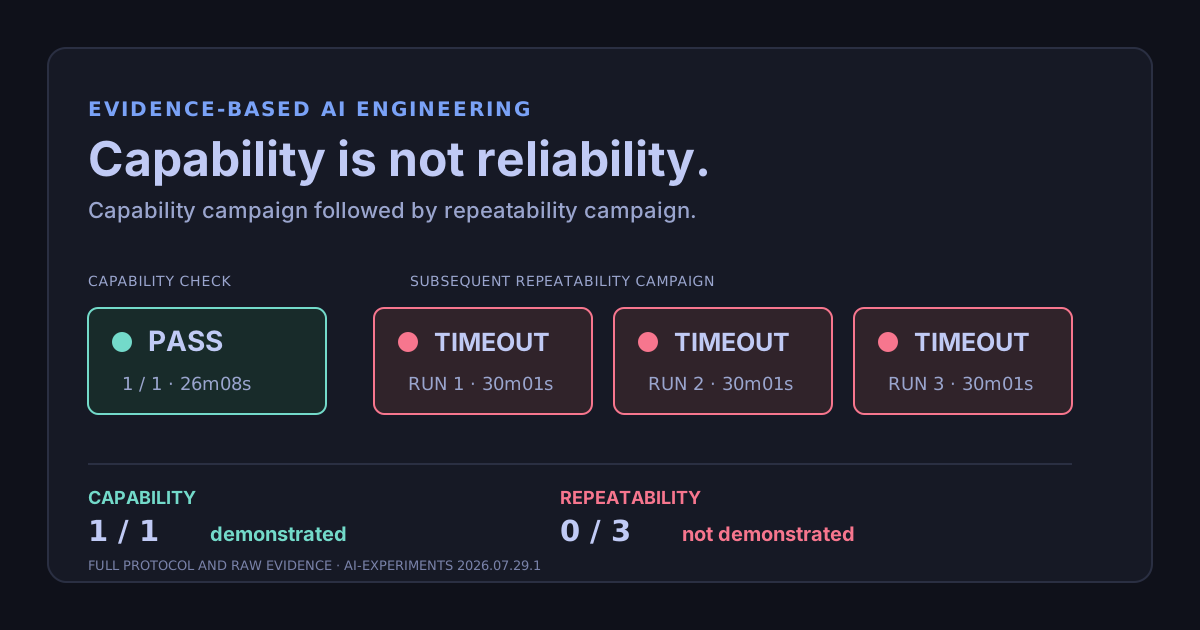
Then I ran the same experiment three more times.
It failed every run.
This is not an argument that coding agents are useless. It is an argument that the unit of evidence matters. A successful demonstration establishes that a system can produce a result. It does not establish how often the result can be produced, how dependent it is on sampling, or whether the process is suitable for unattended engineering work.
The distinction is easy to lose because a good agent run is unusually persuasive. We see the model inspect files, edit code, run tests, repair a failure, and announce completion. The transcript resembles work. The final diff may even be correct.
But one run is still one observation.
The task
I was evaluating local execution in GPTCode, an open-source coding CLI built around explicit research, planning, implementation, review, and verification stages.
The fixture was deliberately small. It contained a Go package with a Store
that writes a named file beneath a configured root:
type Store struct {
	root string
}

func New(root string) *Store {
	return &Store{root: root}
}

func (s *Store) Write(name string, content []byte) error {
	path := filepath.Join(s.root, name)
	if err := os.MkdirAll(filepath.Dir(path), 0o700); err != nil {
		return err
	}
	return os.WriteFile(path, content, 0o600)
}
The implementation was vulnerable by construction. A caller could supply an absolute path, use parent-directory traversal, or escape through a symlinked parent.
The requested change had to satisfy several properties:
- ordinary nested files must still work;
- dots inside a legitimate filename, such as
v1..v2.txt, must remain valid; - direct and normalized traversal must be rejected;
- absolute paths must be rejected;
- a parent directory that is already a symlink must not permit an escape;
- the public API must remain unchanged;
- tests must pass under the race detector;
go vetmust pass.
This is a small task in lines of code, but not a trivial one. Filesystem containment contains edge cases that plausible-looking prefix checks often miss. It was useful precisely because the contract could distinguish a real solution from a convenient approximation.
The contract had already caught a false positive
An earlier version of the fixture appeared to pass with Qwen3-Coder. Human
review found that the generated implementation rejected every name containing
.., including the legitimate reports/v1..v2.txt.
The agent had not solved path traversal. It had prohibited a substring.
The contract was strengthened.
A second weakness appeared on macOS. The temporary root used by the test could
pass through /var, which is itself a symlink. A naive implementation could
therefore appear to reject the malicious case for the wrong reason. The test
was changed to resolve the temporary root before constructing the adversarial
path.
These were not model improvements. They were measurement improvements.
That distinction is important. Better benchmarks often make systems look worse before they make them better. A falling score can mean the evaluation has stopped rewarding shortcuts.
The first Devstral run
I tested Devstral Small 2 through Ollama on an Apple M1 Pro with 32 GB of unified memory.
The initial configuration used a 65,536-token context. Ollama reported a 25 GB runtime footprint with eight percent of the model offloaded to CPU. A 32,768-token context kept the execution fully on the GPU, but the run exhausted the 30-minute task budget without converging.
At 16,384 tokens, the model occupied 17 GB and Ollama reported 100 percent GPU execution. The repository was tiny, so the smaller context still contained the task, source, tests, skills, and retry evidence.
That run completed in 26 minutes and 8 seconds.
The first implementation passed every test except the symlinked-parent case. GPTCode returned the exact deterministic failure to the editor. The second implementation passed:
go test -count=1 -race ./...    PASS
go vet ./...                    PASS
The agent modified one file. The exported API remained unchanged. No paid API was called.
This was a legitimate success against the executable contract. It was also an attractive demonstration:
Analyze
Plan
Implement
Verify
Repair
Verify
Pass
It would have been easy to stop there.
The repeatability run
Instead, I ran the same committed configuration three times.
Each repetition began with:
- a fresh copy of the fixture;
- a new Git repository and baseline commit;
- a required failing baseline;
- the same model profile;
- the same 16,384-token context;
- the same 30-minute budget;
- the same maximum retry count;
- the same verification commands.
Runs were sequential so local resource contention would not bias the comparison. Ollama continued to report 100 percent GPU execution.
The result was:
| Repetition | Result | Duration | Final observed failure |
|---|---|---|---|
| 1 | timed out | 30m01s | legitimate nested paths rejected |
| 2 | timed out | 30m01s | legitimate nested paths rejected |
| 3 | timed out | 30m01s | absolute path and symlink escape accepted |
Pass rate: 0/3.
Median duration: 30m01s.
The model did not ignore the task. It produced relevant plans and several substantive implementations. It recognized traversal, absolute paths, and symlinks. Some attempts came close.
It did not converge within the agreed budget.
In two runs, it tried to validate symlinks by calling lstat or
EvalSymlinks on a path that did not yet exist. This rejected legitimate
nested writes. In another, it implemented lexical containment but failed to
reject an absolute input and a symlinked parent. Some retries regressed a case
that had passed in the previous attempt. One editor cycle consumed twenty tool
calls without producing a diff.
These are not cosmetic variations. They are different failure modes at the security boundary.
Capability is not reliability
The first run and the next three runs are not contradictory.
Together they support a more precise conclusion:
The configuration demonstrated the capability to solve the bounded task, but did not demonstrate the reliability required to solve it repeatedly.
Capability asks whether a result is possible.
Reliability asks how often the result is produced under controlled repetition.
An impressive demo usually answers the first question. Engineering decisions usually require the second.
This is especially important for agentic systems because the visible run is often selected after development, prompt adjustment, model selection, and several discarded attempts. The viewer sees a coherent trajectory. The system owner remembers the search process. Unless failures are retained, neither can calculate what the demonstration represents.
The agent did not fail alone
The experiment also found defects in the surrounding system.
The first Devstral attempt never reached an edit because GPTCode’s Ollama client had a fixed 120-second request timeout. The suite allowed 30 minutes, but an internal client layer silently imposed a much smaller budget. The provider now has a longer local default and explicit controls for request timeout and context length.
The evidence suite originally captured stdout and stderr but displayed them only after completion. A 20-minute local run therefore looked indistinguishable from a hung process. It now supports verbose streaming while preserving the same output in the evidence bundle.
The retry loop could also spend its remaining budget repeating an equivalent test failure. GPTCode now detects a verification plateau and stops after three equivalent failures. Timing noise and Go temporary-directory identifiers are normalized so ephemeral output does not masquerade as progress.
Finally, the execution summary once reported STATUS: FAILED when the final
verification had passed, because it treated recoverable intermediate errors
as the authoritative outcome. Intermediate errors are still retained, but the
final status now reflects the verified result.
None of these changes made the model more intelligent.
They made the system more truthful, observable, and economical when the model was not intelligent enough.
What should count as evidence
For a coding-agent experiment, I now want at least the following:
- The initial repository state, including the baseline used by the agent.
- The exact task and model configuration.
- A clean workspace for every repetition.
- The agent’s stdout, stderr, exit code, and duration.
- The patch produced by the agent, including failed runs.
- Deterministic verification commands and their outputs.
- A final repository snapshot that can be restored independently.
- Human review of what the executable contract does not prove.
- Repetition before making a reliability claim.
GPTCode’s evaluation harness now records these as replayable evidence bundles. A successful agent exit is insufficient. Every required verification command must also pass.
The inverse matters too: a failed run must not disappear. Failed patches show whether the model misunderstood the problem, chose an unsafe approximation, entered a tool loop, or simply ran out of time near a valid solution.
Aggregate scores without failed artifacts conceal most of the engineering information.
Tests establish a boundary, not universal correctness
Even the successful run should not be overstated.
The generated implementation passed the fixture’s traversal, absolute-path, and pre-existing-symlink cases. Human review found that its symlink check and file write were separate operations. A concurrently hostile process could potentially change the filesystem between the check and the write.
The patch satisfied the declared fixture. It was not a race-free filesystem primitive suitable for an active adversary.
This is not a reason to dismiss tests. It is a reason to state their boundary. Executable verification is stronger than the model’s assertion, but it proves the encoded contract, not every property a future environment may require.
Repositories define constraints. Verification establishes truth only within those constraints. Engineering review still decides whether the constraints are sufficient.
From recording studios to local inference
My interest in local models did not begin with a model benchmark. It came from an older change I watched happen in music.
When I started recording, going to a studio was not merely a preference. The equipment, room, engineering knowledge, and production infrastructure were there. If I wanted a serious result, I had to go where those resources were.
Today I record at home. For most of what I need, the tools have become good enough that hiring a studio is no longer the default. This did not make professional studios obsolete. A purpose-built room, an experienced engineer, specialized equipment, and the ability to coordinate a large production still matter. What changed was the boundary between work that required centralized infrastructure and work that could be done well on a personal machine.
Voice production and radio went through related changes. Work that once depended on access to a particular facility can now be produced, edited, and distributed from a much smaller setup. Large studios and broadcast infrastructure remain valuable, but they are no longer mandatory for every recording.
I suspect part of the AI market will move in the same direction.
Frontier-model providers, serverless inference, and managed MLOps will continue to be necessary. They concentrate hardware, operational expertise, model access, and reliability that most individuals and companies should not recreate. But that does not mean every repository question, code review, or bounded change will always need to be sent to Claude, Codex, or another hosted system.
This experiment was an attempt to locate that boundary.
In a separate temporal and concurrency fixture, Qwen3-Coder completed three clean runs with a median of 4 minutes and 7 seconds. Each run passed the race detector and static analysis. The filesystem experiment produced a different answer: Devstral demonstrated that it could solve the contract once, then failed three controlled repetitions.
That is more useful than a general claim that local models are either ready or useless. Some work has already moved into the home studio. Some work still needs the larger room.
The engineering problem is to tell the difference before wasting time or accepting an unreliable result.
The next system should escalate evidence
When a local model stops making progress, the system should not merely restart the task with a larger model and discard everything learned.
It should escalate an evidence package:
- repository facts already inspected;
- the approved constraints;
- patches attempted;
- verification failures;
- plateau or timeout reason;
- commands required to establish success.
The more capable model should inherit the failed work as structured evidence, not as an unbounded transcript. If it succeeds, the same deterministic gates should judge the result.
This creates a useful local-first policy:
Try locally
    ↓
Verify deterministically
    ↓
Pass → finish
    ↓
Plateau or timeout → escalate evidence
The economic question then becomes measurable: how much hosted-model cost can local execution avoid without reducing the final verified success rate?
That is a better product question than whether one model can solve one issue in one recording.
What the failed repetitions proved
The 0/3 result was disappointing if the goal was to publish a successful local agent benchmark.
It was valuable if the goal was to understand the system.
It showed that:
- one pass established capability but overstated reliability;
- the security-sensitive failure class remained unstable;
- longer time did not guarantee convergence;
- context size affected GPU residency and behavior;
- verbose stages were necessary to distinguish work from a hang;
- retry budgets needed a semantic plateau condition;
- negative artifacts contained more diagnostic value than a pass rate alone.
The first successful run is still real.
So are the next three failures.
A useful engineering account must be able to hold both facts at once.
The versioned
fixture,
Devstral suite configuration,
and
result notes
are available in the GPTCode repository. The
versioned experiment record
documents the protocol and limitations. Its
release
publishes the historical run bundles, command logs, patches, verification
results, and repository snapshots under the SHA-256 checksum
6ba0bc9bac3eac5ea9e740bb2e268923aa752f7e186902d5eb443d3a1df5054f.
One successful run demonstrates possibility.
Engineering depends on repeatability.